Platform Overview
Everything your team needs to stay ahead of incidents
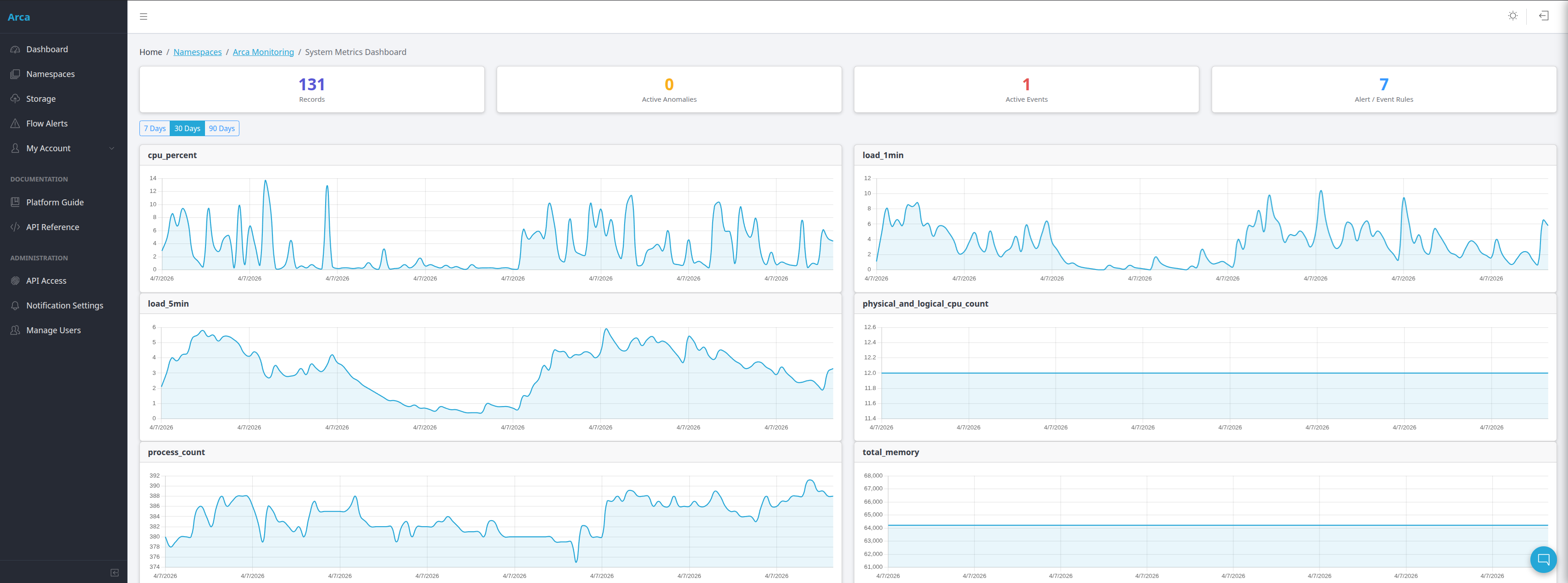
A test install, April 2026. Most of the investigations shown come from Nemesis attack simulations.
Arca replaces your log management and SIEM for Linux and container infrastructure, in one self-hosted platform. Collect and search logs from 18 agents. Detect threats with threshold alerts and 6 SIEM rule types. Investigate with autonomous AI. Respond on your own hosts, with the approvals you set. Manage cases with full SOC workflow. Validate your defenses with built-in AEV — breach simulation and authorized web-app pen testing. Produce compliance evidence. All for $0 per GB.
A test install, April 2026. Most of the investigations shown come from Nemesis attack simulations.
The Arca server goes up in an afternoon. After that, each host joins with one pasted install command (a signed link, good for 7 days), or you download the agent package. Agents run on Linux hosts (Debian, Ubuntu including 26.04, and the RHEL family), macOS, Docker and Kubernetes, and pull AWS CloudTrail. They begin streaming data immediately — no manual configuration of API keys or collection identifiers required. The pack carries an ingest-only key: it can post data and nothing else.
Logs and metrics land in named collections with your schema. Arca indexes up to 55 fields per document for fast querying. Full-text search works out of the box across all indexed fields.
Threshold alerts are checked within about two seconds of each write, and six SIEM rule types every 60 seconds. A new detection opens an autonomous AI investigation — grouped, so one incident is one investigation — that examines your log data with 6 read-only tools, maps the activity to MITRE ATT&CK techniques, assesses severity and the attack's outcome, and writes a structured report. Each incident gets one case with full SOC workflow. On Linux hosts, Sentinel can then block the attacker's address or lock a compromised account, on your approval or on its own where you've allowed it; it kills a process or restarts a service only with approval. You get notified via Email, Slack, or PagerDuty.
18 pre-built agents cover Linux, macOS, Docker, Kubernetes, AWS CloudTrail, and common services out of the box. Any app that posts JSON to the REST API works too.
Six event rule types, checked every 60 seconds, cover the detection patterns that matter most — from brute-force attempts to statistical drift. Threshold alerts run alongside them, with an optional "sustained for" count so one noisy reading doesn't page you.
More than N events within M minutes. Detects brute-force, scan activity, and error bursts.
No data from a known source within M minutes. Heartbeat and host-down detection.
A previously unseen value appeared. Catches new source IPs, unexpected processes, unknown users.
Metric average changed more than N% between two time windows. Rate-of-change detection.
Value deviates from rolling mean by more than N standard deviations. Statistical outlier detection.
Multiple conditions combined with AND/OR logic within a time window. Correlated multi-signal detection within a collection.
Most monitoring tools give you data. Arca gives you an autonomous analyst. New detections are investigated automatically by Claude: it examines your log data with 6 read-only tools, identifies the attacker, maps to MITRE ATT&CK techniques, assesses severity and confidence, judges whether the attack was blocked, attempted or succeeded, and produces a structured report with specific recommendations. An AI chat assistant embedded at every collection and namespace level lets your team ask follow-up questions in plain English. And every hour, Arca writes an AI health digest summarizing the state of each namespace.
This isn't a chatbot bolted on as an afterthought. The assistant starts every conversation with your schema, detection rules and open anomalies, and then looks things up: it counts and groups any field, searches by value or text, and follows an address or a user through every collection, up to 30 days back. Answers come as tables and lists, with a note of what it looked at. It's a conversation about your infrastructure, not a generic one.
The investigation has already answered this. Open the report to see the identified attacker, MITRE ATT&CK technique mapping, severity, whether the attack was blocked, attempted or succeeded, and recommended response actions — or ask the chat assistant for more detail.
If the investigation rated it high or critical, Sentinel has already proposed it. You approve it, or let address blocks and account locks run on their own where you've allowed it. Killing a process or restarting a service always waits for you. Each incident gets one case, tracked through a full SOC workflow from triage to resolution.
The assistant understands your collection schema and data patterns. It can recommend specific alert thresholds and event rule configurations based on what it sees.
Every collection schema, every document, every alert rule, and every anomaly is structured to be AI-readable. When you open a chat, there's no context-switching — the model already has the collection's schema, rules and open anomalies, and tools to look up the rest. We built Arca this way intentionally, because we believe the future of infrastructure monitoring isn't better dashboards. It's better conversations.
In April 2026, Anthropic reported that its Mythos model had discovered tens of thousands of zero-day vulnerabilities in real-world software — autonomously — and its researchers estimated that comparable capabilities would reach other labs within six to eighteen months. When attacks move at machine speed, human-only detection and triage become the weakest link. Arca's investigation and response pipeline was built for this: new detections investigated by AI as they arrive, a block that reaches the host in seconds once approved (or on its own, where you've allowed it), and Nemesis attack simulations that check the detection chain end to end.
Read our full analysis: Mythos Is the Warning Shot →When a SIEM rule fires, Arca doesn't just send a notification. It opens an autonomous AI investigation powered by Claude. The investigation examines your log data using 6 read-only tools, identifies the attacker and affected systems, maps the activity to MITRE ATT&CK techniques, assesses severity and confidence, judges whether the attack was blocked, attempted or succeeded, and produces a structured report with specific response recommendations. It takes minutes, not hours.
It's built not to cry wolf. Related detections are grouped, so one incident is one investigation and one case. Your own deploys and operator logins don't open one, and neither do the OS's own update services. History an agent replays — its first run, or a catch-up after downtime — is recorded but never investigated. A blocked, high-confidence attack that isn't critical closes its own case as "blocked" without paging anyone. Each namespace has an on/off switch and a monthly AI cost cap.
The AI queries collections, reviews anomalies, analyzes entity activity, builds timelines, checks threat intelligence, and assesses severity — with read-only access that cannot modify your environment.
Every investigation produces a report with a summary, severity, confidence, identified entities (IPs, users, processes), MITRE ATT&CK technique mapping, actionable recommendations, and the attack's outcome — blocked, attempted, succeeded or unknown — kept apart from severity.
Four actions on Linux hosts: block an address (ufw), disable a user account, kill a process, restart a service. Off until you turn it on; per namespace, each action is disabled, approval-only, or (for the first two) autonomous.
One case per incident, created automatically, with full SOC workflow — new, triaged, in progress, resolved or false positive. Assign analysts, add comments, track the audit log, print to PDF. Closing a case as a false positive lifts its blocks and account locks.
When an investigation rated high or critical, with at least medium confidence, names a threat, Sentinel proposes a response. The action runs on the monitored Linux host itself, through Arca's responder agent, which checks in every 10 seconds; nothing runs on the Arca server. Once you approve it — or on its own, where you've allowed that — the block reaches the host in seconds. Every action is audited and tied to the investigation and case it came from.
Sentinel is off until you turn it on. Per namespace, each action is disabled, approval-only, or autonomous, and only the two that can be undone — blocking an address and locking an account — can run on their own. Killing a process and restarting a service can't be undone, so they always wait for a person. Each host enrolls, and an admin approves it. Proven live, not simulated, on test hosts: an autonomous block, in place and verified 4.75 seconds after Sentinel approved it, with no human involved (August 2026), and all four actions (November 2026).
Adds a ufw deny rule for the attacker's address, ahead of your other rules, and checks that it took. It stays until you undo it or close the case as a false positive. Operator addresses — where your team signed in from in the last 30 days, plus your own list — are never blocked. Approval or autonomous.
Locks and expires the account, so its SSH keys stop working too. Only an account the investigation found compromised, not one an attacker merely tried. Undo puts the account back as it was. Approval or autonomous.
With your approval, signals one process from the investigation's findings. Protected processes are refused. It can't be undone, so it never runs on its own.
With your approval, restarts one systemd service from the investigation's findings — a hung web server, say. Protected services are refused. Never runs on its own.
Every action goes through one root-owned helper on the host. It refuses protected users, services, processes and networks: the built-ins plus whatever you list in /etc/arca-agents/protected.conf. The list lives on the host, and the host enforces it.
Set an hourly rate limit for each action. Kill switches, for the whole install and per namespace, stop everything at once — including jobs already sent to a host that it hasn't picked up yet.
Claude embedded in every collection and namespace. Ask in plain English: it searches, counts and follows an address or user across every collection, up to 30 days back, and answers with tables.
Every collection gets a dashboard automatically — time series charts with anomaly overlays, word clouds for text fields, and severity-coded markers. No chart building required.
Email, Slack, and PagerDuty — all individually toggleable per alert rule. Threshold alerts are checked within about two seconds of the write; event rules every 60 seconds. A sustained condition notifies at most once every 30 minutes, not once per document.
Case-insensitive substring search across all indexed fields, composable with partition filters and time range queries — from both the UI and the REST API.
Correlate fields from two or more source collections on a shared time bucket. Cross-collection dashboards and anomaly detection with no custom code.
Don't know your schema upfront? Send sample documents, let Arca discover the fields, review the suggestions, and confirm. Buffer-to-collection in seconds.
Ingest, search, collections, and investigations: create namespaces and collections, write single or batch documents (up to 100), and query with filters. Agents post with an ingest-only key; everything else needs a full-access key. Rules are managed in the UI.
Documents stored on your filesystem in configurable slices. Set per-collection expiration and compression thresholds. Documents an investigation cites are kept. Storage shows on the Operational dashboard.
Each agent type ships with 2 to 8 curated alert and event rules, 90 in all, pre-tagged with MITRE ATT&CK techniques. Review and create them in one click — no configuration from scratch.
Coverage matrix across all 14 ATT&CK tactics. Technique chips on every investigation report. See which ATT&CK techniques your detection rules cover and where gaps remain.
CISA KEV, abuse.ch URLhaus and ThreatFox, and AlienVault OTX, plus an opt-in Newly Registered Domains feed. Automatic enrichment of investigations with known indicators of compromise, and rules that fire on a successful login from, or a connection to, a listed address.
SOC 2 Type II, HIPAA, PCI DSS v4.0, and NIST CSF. Evidence evaluated from live platform data, in print-to-PDF reports for your auditor, with the gaps Arca can't evidence listed honestly.
Operational, Threat Intel, Executive, and Security dashboards, plus a Sentinel dashboard and an AEV overview. Pre-built views that give different stakeholders the data they need without custom configuration.
Leaflet-based map of where your investigated attacks came from and what they hit, correlated with SIEM detections, AI investigations, and threat intelligence data. Geolocated on your server: no address leaves it.
Admin, analyst, read_only, engineer, IT, and pen_tester roles. Engineers and IT see log management only — SOC surfaces (investigations, cases, compliance) are restricted to security roles. A pen tester can run pen tests without seeing the SOC.
Arca ships both halves of adversarial exposure validation (AEV) — the category Gartner formed when it merged breach-and-attack simulation with automated penetration testing. Nemesis (BAS) validates your detection pipeline from the inside; Nemesis (Attack) tests authorized targets from the outside.
Nemesis (BAS) runs 66 attack scenarios across 38 MITRE ATT&CK techniques (52 counting sub-techniques), all 14 Enterprise tactics, and every SIEM rule type. It replays synthetic attack telemetry and doesn't stop at whether a rule fired: it grades at the investigation level, checking that the investigation finished, named the right attacker and host, reached at least the expected severity, and described the attack. No standalone BAS tool can grade this deep, because none own the detection layer. In the last full run, on November 10, 2026, all 66 passed.
It runs inside Arca, with nothing else to buy, on your own Anthropic key: that full run took about four hours and $15.92 of AI. Responses during a run are simulated and never reach a host. Schedule runs, trigger them from CI with a webhook, export run history as CSV, and follow coverage over time on a trend heatmap.
A real, authorized web-application pen test — reconnaissance to client-ready report. Every launch requires the operator to attest they have permission to test the targets, and each attestation is kept with the user, time, and targets.
Consolidated discovery — port and service scanning, TLS inspection, HTTP crawl, SSH banner grab, and DNS enumeration. Port chaining points each probe at whatever recon actually finds open, not just the defaults.
An automated scanner runs an active audit against the chosen targets, with optional authenticated scanning — credentials are entered at run time and never stored — and selectable intensity to keep large scans bounded. Each run scans in its own isolated project. A time cap, a Stop button, and the kill switch keep every scan under your control.
Claude reads the findings plus recon context, on your own Anthropic key, and writes an executive summary and a show-your-work reasoning trace. Export a comprehensive report or a one-page executive summary (print-to-PDF), plus machine-readable JSON. For medical-device teams, a Submission Report for FDA premarket review adds a disposition and CVSS score for each finding, plus the engagement details. Reconnaissance exposures roll into the risk verdict so nothing serious is buried.
Arca gives your auditor the evidence it can prove from its own records, and lists what it can't. Evidence reports evaluate your detection rules, investigation coverage, response actions, and logging completeness against the controls of four frameworks, over an audit window of 30 to 365 days, and print to PDF. Nemesis's simulated attacks are kept out of the operational evidence and counted only as testing.
Controls that need written policies, physical security, MFA, or backup procedures are flagged as gaps, not claimed. Arca isn't a GRC platform and doesn't make you compliant. It saves you assembling, from screenshots and spreadsheets, the evidence it can prove.
Evidence for your CPA firm's Type II examination: 15 Trust Services Criteria controls evaluated. Covers logical access (CC6), system operations (CC7), change management (CC8), and more.
13 implementation specifications evaluated. Administrative, physical, and technical safeguards mapped to platform evidence where Arca has it, and flagged where it doesn't.
15 requirements evaluated. Emphasis on logging (Req 10), vulnerability scanning and security testing (Req 11), and access control (Req 7–8). Scan and web-app pen-test evidence counts as partial: an ASV scan and a network pen test are still required.
13 categories across Identify, Protect, Detect, Respond, and Recover. Gap analysis with maturity scoring on a 1–5 scale.
Arca syncs four curated threat intelligence feeds, plus an opt-in feed of newly registered domains. Indicators of compromise are automatically correlated with your investigation data and surfaced as "Known Threat" badges on investigation reports. The Known-Bad IP Login and Known-Bad IP Connection rules fire on a successful login from, or a connection to, a listed address. The Attack Map provides a Leaflet-based geographic view of your investigated attacks.
Feeds sync automatically every 6 hours. Admin UI for feed management and manual sync.
One row per outside address hitting your web, SSH, login-history, UFW, and fail2ban logs: what it did, which hosts it hit, where it is, and which feeds list it. A row is raised for review only when it matters — a secret file served, a login, a feed hit, SSH guessing fail2ban missed, web probes. Ban it on one host or all of them, through Sentinel.
Full-page Leaflet-based world map of the origins and targets of your investigated attacks. Attackers appear as pulsing red dots, targets as blue dots, with smooth bezier attack vectors color-coded by severity. Hover popups show IP, city, country, ISP, and linked investigations. Geolocation runs on your server, so no address leaves it. Opens from any investigation page.
Operational (storage, ingest, agent performance), Threat Intel (feed health, indicator trends), Executive (KPIs, resolution time, platform value), and Security (MITRE heatmap, kill-chain depth, risk ranking), with time-window filters from 7 to 90 days. Plus a Sentinel dashboard that shows why each proposal that didn't run didn't, and an AEV overview of both Nemesis engines.
Arca has protected our own servers in production since November 2026. Early access means we install it with your team: we check each server for signs of intrusion before agents go on, then tune Arca to your hosts. Arca is self-hosted, with no per-GB billing; the AI features run on your own Anthropic API key, with a monthly cost cap per namespace. To get started, send us an email with a brief description of your infrastructure and security needs and we'll be in touch within 24 hours.
Request Early Access Ask a Question